• Free Shipping on all orders over $49 • $5.99 Flat Rate Shipping on orders under $49.

  • blue_solid_circle-white_bg-svg
  • Free Shipping on all orders over $49 • $5.99 Flat Rate Shipping on orders under $49.

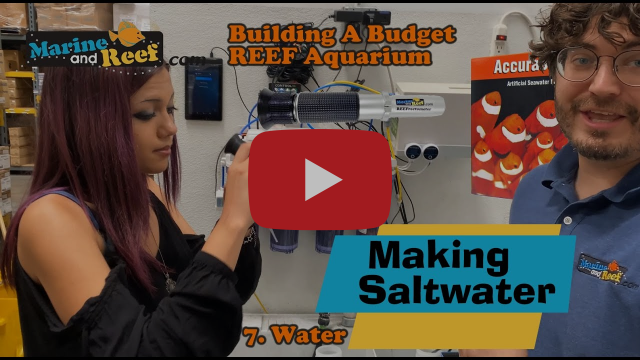
Building A Budget REEF Aquarium: Step #7 Making Saltwater

What do you mean I can't just put table salt in my fish tank?


In Part #7 of our 30-episode series on Building A Budget REEF Aquarium, we show you how to make salt water.

This week I'm joined by our newest employee, Kat. Now that I'm setting up a tank in my office is, I'm going to pass over the reins of the other tanks in the office to Kat. I have too many tanks.

Kat has only had fresh water before. She had a 30-gallon before that had corydoras and guppy fish, and a 10-gallon that she kept a betta fish in. This will be her first experience with saltwater.

If you have a saltwater aquarium you're going to need two kinds of water. You're going to need fresh water and you're going to need salt water. Anyone with a saltwater aquarium will need clean, fresh water for topping off the tank and saltwater for water changes. Top-off water is for replacing water that evaporates out of your aquarium. Only the water evaporates. The salt stays in the tank. So when the water evaporates out of an aquarium you need to replace it with fresh water. When you set up a new aquarium, as we're doing in this video series, you need salt water. You'll also need salt water when doing water changes because you will be removing salt when you remove the water for the water change.

As for your fresh water for reef aquariums, we recommend you use
RODI water or RO water. Here we have our fancy SpectraPure office RO system that we use for all of our tanks. If you're on a budget some of these are less than $100. The AquaticLife RO Buddie is a great value and it is less than $100. You can save money by making your own RO water at home.

Another option is to get your water at the local fish store. For years when I was at a fish store we sold it for 30 cents a gallon. You can just pick up some purified water at the fish store.

For our video demonstration, we've already prepared a five-gallon jug of RO water. For the salt, we recommend the
Two Little Fishies AccuraSea1 Salt. This is what we use here in the office. What is super cool about this salt is it comes in a packet that makes exactly five gallons of salt water. We use a five-gallon water jug and we have a five-gallon packet of salt. We just need to rip open the salt packet and pour it in. There is no need to measure the salt. The whole box is ten packets that each make five gallons of salt water.

When using aquarium salt we highly recommend mixing the entire box or bucket of salt all at once because the trace elements in the salt may not be perfectly distributed in the container. Because the Two Little Fishies AccuraSea Salt comes in five-gallon packets, it's very easy to use up the entire packet in one go. This is not nearly as easy when using the typical fifty-gallon bucket of competing salts.

Once you add the salt you need to mix the salt. For this, we use a little
Lifegard Aquatics Quiet One Pro Model 200 Pump. You want the pump to run for at least a couple of hours to be sure the salt is completely dissolved and evenly distributed. That's how simple it is when you have a five-gallon container and five gallons worth of salt.

We know a lot of people are trying to mix 50 gallons or more water at a time, and they don't know the exact measurements. If you need to check and make sure your salt water is mixed correctly the way you do that is with a reefractometer (aka refractometer in the rest of the universe). A MarineAndReef.com Reefractometer is included with most protein skimmers we sell at MarineAndReef.com, so if you bought your protein skimmer from us you might have gotten one of these for free. We sell the
MarineAndReef.com Reefractometers for a very reasonable price. You can get them cheaper on Amazon, but those cheepo reefractometers are not the same quality. This quality of reefractometer usually costs twice as much.

The first thing you want to do with a reefractometer is make sure it's calibrated and reading correctly. The way you can calibrate it is you can use either a
calibration solution or you can use purified water. Because we're on a budget we're going to use purified water. Just take a sample of the purified water, put it on that blue portion, and close it down. Then you hold it up to the light. In a bright room, it works a lot easier. There should be two scales. We usually read the scale on the left. If it reads "one" that means the water in the reefractometer weighs as much as the same amount of purified water, which is what we have. If it reads lower, or if it reads higher, you can adjust it using the little knob on top.

Then flip the lid back up. I usually just brush the water off. Take a sample of some mixed salt water (for the demonstration we have some already mixed saltwater). Generally, you're looking for between about 1.022 to 1.026. The sample in the demonstration is 1.022. No surprise. With Two Little Fishies AccuraSea Salt, it always comes out perfect.

If you want the products to make salt the way we make it, we sell a bundle that includes
two water jugs, Two Little Fishies Salt, and the Lifegard pump. It's a great way to mix your salt at home.

More Info Product button block
  • Please contact us with any questions you have.

  • [email protected]

    We answer all emails through 3 PM the same day (M-F).

  • (480) 491-5283

    Monday-Friday 9:00 am to 11:00 am & 1:00 pm to 3:00 pm MT. We will return all phone calls through 3 PM the same day.

    Note: we do not have daylight savings time in Arizona

Empty Cart