Free Shipping on all orders over $49 • $5.99 Flat Rate Shipping on orders under $49.
Free Shipping on all orders over $49 • $5.99 Flat Rate Shipping on orders under $49.
Free Shipping on all orders over $49 • $5.99 Flat Rate Shipping on orders under $49.
Free Shipping on all orders over $49 • $5.99 Flat Rate Shipping on orders under $49.
If you are new to keeping aquarium plants, then the sheer number of plants to pick from can be overwhelming. Here is a list of the six most common types of water plants you will find in the aquarium hobby, along with some tips when it comes to care and scaping.
Mosses are short plants that grow only on hard surfaces. They are typically sold as loose balls or attached to clay or mesh. Some common mosses include Christmas moss, Java moss, flame moss, and weeping moss. In general, mosses are some of the easiest plants to care for. Mosses can often grow in aquariums with no fertilizer, CO2, or dedicated plant lighting, but they do grow faster in aquariums with high-end planted equipment. Most mosses are also semi-aquatic—meaning that they can grow in moist environments such as the top of a piece of driftwood poking out of the water. They are great to add to waterfalls or to paludariums.
One thing every new moss keeper asks is how to get their new moss to adhere to the wood or rocks in their aquarium. You can use some string to tie the moss on and then wait for it to attach, but our favorite method is to use an aquarium glue like our MarineandReef.com Glue. Simply apply some of the glue to your clump of moss, and then press it against your desired surface. The glue will hold it in place long enough for the moss to attach, and then the moss will continue to grow attached to the surface.
Floating plants are pretty easy to identify. They float on the water’s surface and have roots that dangle down into the water. Some common floating plants are water lettuce, red root floaters, sylvania, and duckweed. Floating plants are very easy to care for and can often survive without dedicated planted aquarium equipment. They do have some downsides. Floating plants can shade out plants rooted in the aquarium, inhibiting their growth. Floating plants also grow very quickly and can become weeds, quickly taking over the aquarium surface. Floating plants generally look the best from the top down. This makes them well-suited for rimless tanks, where you can easily look down at the tank, but for rimmed tanks with lids, you likely won’t get to enjoy them fully.
Rhizome plants have a thick woody rhizome that their roots stem off of. These plants are generally easy to care for, but they are more demanding than mosses or floating plants. Some common rhizome plants are Java fern, anubias, cryptocoryne (crypts), and tiger lotus. Rhizome plants should generally have their rhizome partially buried, but not completely. If the top of the rhizome is covered, then the stem will rot off, and the plant will die. There are also some rhizome plants like Java fern and anubias that can grow on wood. This makes for a beautiful vertical look. We use MarineandReef.com Glue to attach the plants to the wood. Rhizome plants are slow growers and will require slightly more light and fertilizer than floating plants or mosses. They also benefit from the addition of compressed CO2. Most of these plants would be considered easy to moderate in their care requirements.
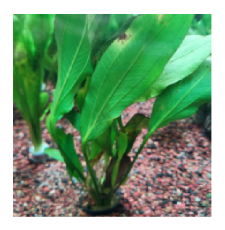
Rooted plants are just big stem plants, but they are larger and generally easier to care for. You will commonly see rooted plants sold in pots. The most common rooted plants are sword plants such as Amazon sword, melon sword, and flame sword. Rooted plants should be planted in a soil substrate and benefit greatly from root tabs placed at their base. They generally are more demanding in regard to light, CO2 and fertilizer (such as Seachem Flourish products) than the previously mentioned plants. These rooted plants can grow very tall and large, and some are semi-aquatic, growing out of the aquarium while their roots stay in the water. These plants are very popular and are commonly called background plants because they are so large that they are best placed at the back of the aquarium. When trimming rooted plants, trim off whole leaves. If you want to keep the plant small, trim the large leaves at the base. Smaller leaves will replace the larger ones. If you trim them “lawnmower style,” cutting across the leaves, then most of the leaves will die, and you will be left with a much uglier-looking plant.
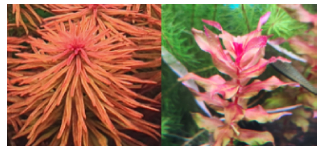
Stem plants are some of our favorite plants, but they are a bit more demanding. Stem plants can grow quickly, but in order to grow quickly, stem plants need lots of light, CO2, and fertilizer. Some common stem plants include ludwigia, rotala, cambomba, bacopa, and hygrophila. Stem plants are commonly sold as bundles clamped together by plant weights or string. These bundles can be pushed into a soil substrate, where they will eventually form roots, or the bundles can be separated and the individual stems planted. Stem plants come in bold greens and reds and can be very beautiful, but they often only look their best and grow the fastest in tanks with high-tech gear like powerful lights and a compressed CO2 system. This is not to say that they can’t grow in low-tech tanks, but they will likely never have the same bold colors and explosive growth. Stem plants can be trimmed “lawnmower style” by simply cutting the stems shorter. The trimmings can then be bundled together and replanted or given to a friend.
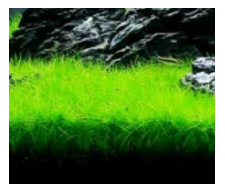
Carpet plants look like a beautiful underwater grassy meadow when grown out. They grow over soil but do not get very tall, and they are often called foreground plants because they are commonly placed at the front of the tank with larger plants behind them. In general, carpet plants are very fast-growing and difficult to care for. They do best with high light, CO2 injection, and plenty of liquid fertilizers. Some common carpet plants include dwarf baby tears, dwarf hair grass, dwarf sage, and glossostigma. The larger species tend to be easier to care for, with dwarf sage being one of our favorites. Unfortunately, hair grass and dwarf sage can still grow 2-3 inches tall, so they only look like carpets in larger tanks.
Carpet plants usually come attached to mats. To make your carpet take portions of the mat it is attached to, push the roots down into the substrate. Eventually, the plants will grow and spread out across the bottom of the tank. You will need to trim the mat to keep it looking pristine. You can trim the mats straight across the top with a pair of plant scissors.
We answer all emails through 3 PM the same day (M-F).
Monday-Friday 9:00 am to 11:00 am & 1:00 pm to 3:00 pm MT. We will return all phone calls through 3 PM the same day.
Note: we do not have daylight savings time in Arizona