• Free Shipping on all orders over $49 • $5.99 Flat Rate Shipping on orders under $49.

  • blue_solid_circle-white_bg-svg
  • Free Shipping on all orders over $49 • $5.99 Flat Rate Shipping on orders under $49.

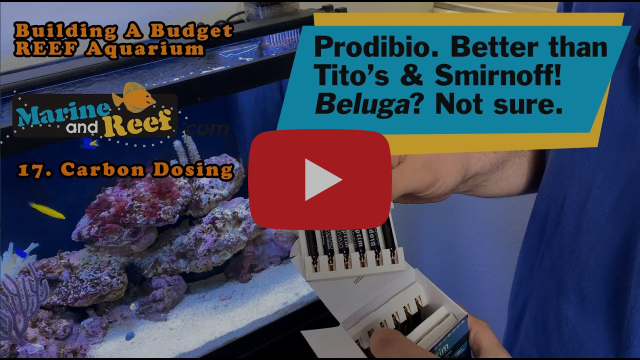
Building A Budget REEF Aquarium: Step #17 Carbon Dosing

How to control nitrates using carbon dosing in your reef aquarium?


If you guys have been following our full video series, we've done a previous video on cycling the tank, and in that video, we mentioned that when you start putting fish in the tank they will produce ammonia. Ammonia gets converted into nitrite and nitrite gets converted into nitrate. Nitrate builds up in your water as a consequence of the nitrogen cycle. It can at some point start to poison the corals in your tank. And it can also lead to a lot of algae growth in the tank. We've started to get a little bit of a brown haze in the bottom of the sand. Some of that is unavoidable, but we want to minimize as much of that as possible, and one way we can minimize that is by doing a better job of controlling nitrates in the aquarium.

As a general rule, we're going to want the nitrate levels to be 20 or below. When I last tested they were at 15, so they're still acceptable, but we've seen them slowly going up.

One way to reduce nitrates is through water changes, and for info on that subject please watch our water change video. But I've decided I don't want to do any more water changes. I'm doing my five gallons a week. I really want to keep to that schedule. On a small tank, it may be a lot easier just to do more water changes. It may mean that on my 30-gallon tank I do five gallons a week instead of two gallons a week, and the nitrates are under control. That is a simple, very easy, budget-friendly solution.

So we want to implement some method of better keeping nitrates down and controlling them. There are basically three ways you can do this. The first one is the one I already mentioned. You can just do more water changes. The other solution we could do is we could use some form of algae filtration. The algae uses the nitrate as a fertilizer when it grows so as the algae grows in our filtration device it pulls the nitrate out. We then take the algae and toss some of it out. Let it regrow. And that removes nitrates. This would be with a refugium growing some kind of chaeto or other macro algae, or an algae turf scrubber that grows turf algae on a sheet. And while those work really well, we're trying to keep this tank on a budget and those solutions would mean buying a refugium, or a media reactor, or a turf scrubber which could cost a couple hundred dollars, and we're trying to keep this tank affordable. The next solution is the one that we're going to look at and that's carbon dosing.

We have an Aquarium Organic Carbon Dosing Article on MarineAndReef.com all about the science of carbon dosing, but I'll simplify it for you. Some bacteria will eat and break down nitrate in the water, but they usually don't exist without some help. So to help them along we're going to add organic carbon, and that's why we call it carbon dosing. We add a food source so that those natural bacteria can proliferate and start to break down the nitrate on their own.

I use Brightwell's Reef BioFuel in my home aquarium. There are many similar products. BioFuel does the same thing as biopellets such as Two Little Fishies NPX Bioplastics. They add a food source for the natural bacteria in the tank. But, generally, with most of those products you need to add them every day and I don't want to add them every day.

To keep this budget, we don't want to buy a dosing pump to automatically add it every day. Instead, I decided to use the Prodibio system. This is a carbon dosing system to dose organic carbon to the water to process nitrates, but has a unique way of dosing. It makes it a lot easier than many of the other methods. It uses Bioptim, which is the organic carbon source. To feed the bacteria there is BioDigest, which is the living bacteria.

With carbon dosing, it's generally best to pair a bacteria with the carbon. A single vial of both Bioptim and BioDigest treats 50 gallons. We have a 55-gallon tank here with some rocks displacing stuff, and with Prodibio BioDigest and Bioptim you only need to add one vial every 15 days. I add one vial of Bioptim every Friday, and then the following Friday add one vial of the BioDigest. How simple is that?

This Prodibio method doesn't require a piece of gear that's very expensive. I don't have to buy a dosing pump. It really fits the budget theme of this tank very well.

Adding the vials of Prodibio does not require any measuring. The vials have two glass ends that snap off. You snap the first one, and then when you snap the second the liquid runs out into the tank.

Using Bioptim and BioDigest we've carbon dosed the tank. That's going to help control the nitrates in the water. It's a super simple method.

If you like what you're seeing in these videos stay tuned for more. We're going to talk about customizing the filter media. We're going to show you as we add more and more animals to the tank, and you're going to see this tank come along nicely. Thank you very much!
More Info Product button block
  • Please contact us with any questions you have.

  • [email protected]

    We answer all emails through 3 PM the same day (M-F).

  • (480) 491-5283

    Monday-Friday 9:00 am to 11:00 am & 1:00 pm to 3:00 pm MT. We will return all phone calls through 3 PM the same day.

    Note: we do not have daylight savings time in Arizona

Empty Cart