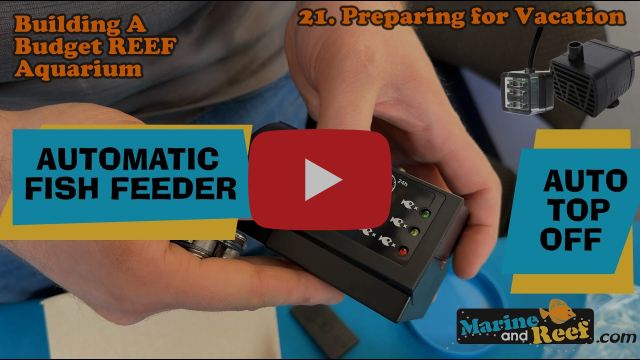
Building A Budget REEF Aquarium: Step #21 Preparing For Vacation
Take care of your reef aquarium from anywhere!
![]()
In this video I go over two products I'm adding to my office aquarium to prepare for being on leave. In general, these are products you might want to add when going on vacation. In this case I'm going to miss work because my wife is expecting our second child!
Before getting into the two "vacation" products I'll give you an update on our marine velvet disease outbreak. In a previous video we set up a fish trap to treat our fish. We were able to save those last few fish. They've been put back in. We've also added a few fish in. Overall the tank seems pretty happy.
Anyway, my wife is going to have a baby next month, which means I'll be out for a few days. And I don't know exactly when. The last one came early. What we're going to talk about today is how to get your tank ready for when you're not around. Nobody's going to be at home all the time. You're going to have to be out for a baby, or for a vacation, or some kind of planned trip. Or maybe your tank is in an office where you're gone every weekend, where you're not going to be there two days of the week just as a normal occurrence. I'll show you how to get your tank ready for you not being there.
Before we get into some of the gear we've purchased to help out with getting the tank ready there's some general things you want to go over. The first one is something you should not do. And that is never ever, ever make any substantial changes right before you go out of town. I once put a media reactor on my tank and I didn't intall it correctly. It was leaking just a little bit, but by the time I came back there were 30 gallons of water on the floor. So, I would never recommend making any immediate changes to your tank right before you go out of town. I'm going to recommend that you make those changes at least a few days before you're planning on leaving.
Also, before you plan on leaving I'm going to recommend that you make sure all your equipment is functioning properly--the pumps are clean, the filters clean, and you have fresh media. Do this at least one to two days before leaving so you can make sure everything's working and nothing is leaking. Be confident things are working before you leave.
The gear I've chosen is not essential. You can just do these things daily yourself. These are not products you have to have, and because this is a budget tank, we didn't install these right away because we're trying to keep the cost as low as possible. But we know that everybody's probably going to go out of town, so we're going to give you guys some budget options for some basic automation on your tank.
The first thing we've selected is this
Hydor Automatic Fish Feeder. This is the most affordable automatic fish feeder that we sell, and that's the reason why I selected it for this budget tank. But it is also a good fish feeder. I've used these before. They work very well, they're reliable, they do exactly what they're supposed to do, they're super simple and they also have an airline connection to prevent the food from getting super moist. Here in Arizona that's not a big problem. But I do specifically recommend these feeders to people in humid environments who complain about the food getting very humid and moist and clumping together. It's really the only feeder I know of that has that airline attachment so you can connect the air pump to keep it dry. We're not going to do that here. Again we're in dry climate so we don't really need that.
I've had aquariums for 15 years, and every time I trusted someone to feed my fish I came back and the tank looked disgusting because someone fed way too much food. The Hydor Automatic Fish Feeder will be feed the fish consistently and reliably. And it's definitely cheaper than paying someone to show up at your house and feed the fish.
The food we've been feeding is this
New Life Spectrum Marine Fish. Just pour some of that pellet food into the feeder. And then it's going to automatically feed the fish once a day. The feeder is pretty simple. Basically you choose either one, two or three feedings a day. And with most feeders you're going to see a clock where you can set when you want the feedings. This one is super simple. When you put the batteries in that is when it feeds. And if you set it to feed two times a day, then it splits it up into two times. And if you have three times, it splits it up three times. And that is it. There's nothing else to program, which keeps it super simple.
You can set the dispenser to dispense the appropriate amount of food. I always want to go on the low side.
Just place the feeder on the edge of the aquarium somewhere above an opening in the aquarium. With this tank I can place it on the edge or the filter or on the light. If you really want it to stay in place you can use some double-sided tape to keep it firmly centered.
Often these feeders will have enough food to last for a month or more and the batteries often last multiple months. But we do suggest that, if you're planning on going out of town, it's a good idea to swap the batteries out and make sure that they're fresh.
The next piece of gear we've selected is this
Ice Cap ATO or Automatic Top Off. These are great. I personally would never consider setting up a tank without an automatic top off because it is such a labor saver. And in this case we really need to keep this tank topped off because if it starts to go down, the filtration will not function properly. The protein skimmer will no longer surface skim, it won't feed into it correctly. The filter also surface skims, it's not going to do it correctly if the water level drops.
Also, keep in mind that whenever the water evaporates the water leaves, but the salt doesn't. So your salinity shifts up and it creates a lot of instability in the tank if you don't keep it topped off. So, by us putting this auto top off system in place we'll be able to put a bucket below the aquarium, fill it with water, and then the auto top off system will automatically replace the evaporated water as it happens, letting us leave for a couple days knowing the water level will not drop.
To see how the ATO works, you really need to watch the video. But in general, there is a pump that pumps the water from a container (not included) up to the tank. The included hose connects to the pump and runs up to the tank and is held in place with the included bracket. A siphon breaker put into the hose line (you cut the hose in two) so the water only runs in the direction you want. The sensor connects to the same power supply the pump connects to. The sensor is held in place on the back of the tank.
As the water level drops to the low water level the sensor trips and turns on the pump until the water level reaches the middle sensor and then the pump turns off. There is a third higher level failsafe sensor in case the middle sensor does not work. The third failsafe sensor is a great feature. It used to be only the very expensive ATOs had this feature. Basically, as the aquarium water evaporates the ATO replaces the water.
The container I use came with the Tunze Comline Reef Pack that I set up with on this tank in one of the first vidoes. It was designed to be an auto top off container. It has a nice lid and that's going to limit the evaporation of the top off water. We cut a little notch to route the wire and the tube through, so it's nice and firm. Dust and debris won't get in that top off water and the evaporation of this bucket is going to be limited.
The question you want the answer to before you leave town is how long with the top reservoir last? You will want to have the top off running for a while before leaving town so you can be sure there is enough top off water. I found that this bucket lasts about four to five days. This will be enough for my purposes. I'm actually not leaving town. I'll stop by work every couple of days to check on things. But if need be I could set up a 20 gallon sump below this tank and have enough top off water for a month.
While the Automatic Fish Feeder and ATO are not absolutely necessary, and you may not be able to afford them at first, they are probably the first two upgrades you will want. It'll make you tank maintenance so much easier and give you piece of mind when you are away from your aquarium.
Next we're going to do some more videos on fragging. We're going to do some videos on adding more fish in, update you on how the corals and fish we've added are doing. And if that sounds good, then like and subscribe for more.