Free Shipping on all orders over $49 • $5.99 Flat Rate Shipping on orders under $49.
Free Shipping on all orders over $49 • $5.99 Flat Rate Shipping on orders under $49.
Free Shipping on all orders over $49 • $5.99 Flat Rate Shipping on orders under $49.

All aquariums need a light. They are important for the health of your animals and for aquarium enjoyment. Depending on the type of aquarium you have, your lights will serve different purposes.
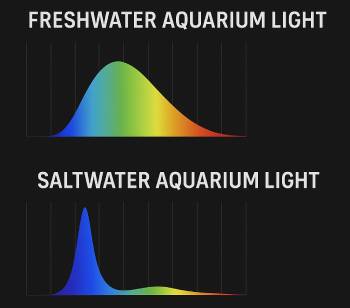
The biggest difference between freshwater and saltwater aquarium lights is color. Most freshwater aquarists prefer a warmer or whiter light on their freshwater aquariums, while most saltwater aquarists prefer a cooler or bluer color light on their saltwater aquariums. Ultimately, your animals don’t care much whether the light is bluer or whiter, but you will likely be very unhappy if you don't buy a light designed for your type of aquarium, whether freshwater or saltwater. Within the categories of freshwater and saltwater lights, there is also additional variation in light color. One of the best ways to ensure you will be happy with how your aquarium light looks is to purchase a controllable LED light that lets you adjust the spectrum by controlling different colors of LEDs. Most modern LED lights have some kind of control.
Lights we offer with control include Kessil, Ecotech Marine, AI (Blades, Prime & Hydra), Aqueon, Reef Brite, and Fluval (Marine, Fresh).
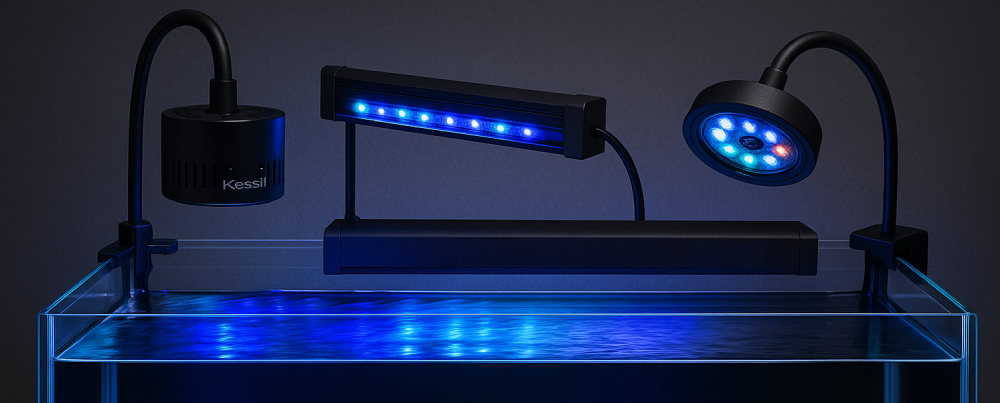
There are three main types of light form factors: complete fixtures, pendants, and strip lights. Complete light fixtures are designed as all-in-one lighting solutions for aquariums with high light requirements. An example of a complete fixture-style light is the ReefBrite XHO Actinic & 50/50 LED Strip Lights. With these light fixtures, you simply purchase the fixture that matches the length of your tank, and you have a solid light for even demanding aquarium types, such as reef aquariums. The advantage of a complete fixture is that you only need to buy one item. No additional mounting or controllers are needed, and there is only one power cord. This makes complete fixtures a very simple and clean solution. The downside to fixtures is that they are difficult to upgrade or move to a new tank. If a new tank is a different length, you likely won’t be able to use the fixture again.
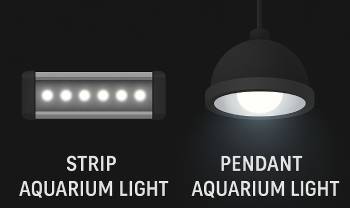
Light pendants such as the Kessils, AI Hydras & Primes, and Ecotech Radion LEDs are spotlights that emit light from a relatively small puck-shaped light fixture. Most aquariums will need multiple light pendants to completely light the tank. Generally, you will want about one light pendant for every two feet of aquarium length, so a four-foot tank will require two pendants, and a six-foot tank will require three pendants. The advantage of this form factor is that it is very easy to add more lights as you go. You can simply shift the pucks down and add another light. If you upgrade your tank, then you can take the two lights from your four-foot tank and add one more to light your six-foot tank. The downside to this light form factor is that you will often need to purchase additional mounting solutions to use the lights. This includes mounting arms, rails, and hanging kits. Additionally, pendant-style lights tend to cast shadows because the light is coming from a relatively small source. This looks visually interesting in the tank, creating ripple lines and dynamic shadows, but when growing plants and corals, this style of light often causes the bottoms of plants and corals to get underlit, or taller plants and corals to shade out shorter ones. Because of this disadvantage, pendant-style lights are used in conjunction with strip lights.
Strip lights are long, thin light fixtures that travel the full length of the aquarium but are not super bright or intense. For fish-only aquariums without plants or corals, or for smaller aquariums with plants and corals, a single strip light may be all that is needed to light an aquarium. For larger aquariums with plants and corals, multiple strip lights will be needed, and they are often used in conjunction with pendant lights. Strip lights are one of the most affordable lighting options and are typically what we recommend for fish-only aquariums. For reef and planted aquariums, strip lights are often the best budget option, but for larger aquariums, you may need to buy three or more lights to get the intensity you want. This may make pendant lights a better option. Most pendant lights do not require additional mounting hardware, but you may find that, for your particular application, you want special canopy mounts, raised mounts, or rails to link multiple lights together. Strip lights are excellent at creating a floodlight effect that eliminates shadows. This is great for plants and corals, but it can create a “flat” look without the ripple lines or dynamic shadows many people prefer.
Hybrid lighting is when a combination of light types is used. The most common combination is strip lights used in conjunction with pendant lights. This combination has given us the best lighting performance we have found in aquarium lighting. The pendant lights provide plenty of intensity and create visually interesting light ripples, while the strip lights fill in the gaps so that everywhere in the tank is still getting some light. ReefBrite makes hybrid lighting fixtures that have strip lights with a mounting spot in the middle for pendant lights. These are great for creating the hybrid setups of your favorite pendant and strip lights.
Aquarium lights range from $10 to over $1,000. And with some of the most expensive lights, you may need to get more than one for your aquarium. What makes these lights so pricey? Here is a list of features that get better the more you spend on your light.
We answer all emails through 3 PM the same day (M-F).
Monday-Friday 9:00 am to 11:00 am & 1:00 pm to 3:00 pm MT. We will return all phone calls through 3 PM the same day.
Note: we do not have daylight savings time in Arizona