• Free Shipping on all orders over $49 • $5.99 Flat Rate Shipping on orders under $49.

  • blue_solid_circle-white_bg-svg
  • Free Shipping on all orders over $49 • $5.99 Flat Rate Shipping on orders under $49.

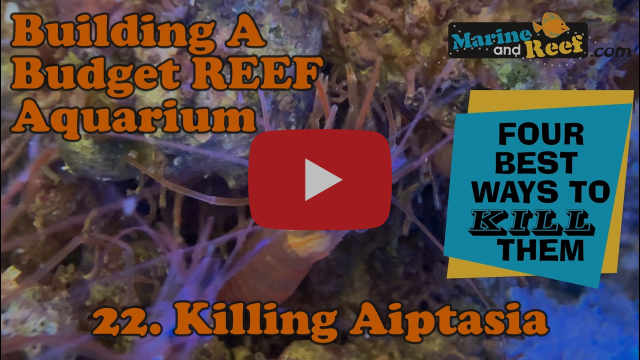
Building A Budget REEF Aquarium: Step #22 Killing Aiptasia

How to get rid of aquarium pest!


In this video we move back to our BioCube tank, which we haven't shown in a while. We've been ignoring this tank now we have a massive aiptasia outbreak problem. I'll show you some differnt methods for treasting this problem.

What are aiptasia anemones? Aiptasia anemones are a pest anemone that is extremely common in this hobby. They can come in on corals or on live rock and once they get in they are amazing at reproducing and spreading all over the tank. It looks really ugly to have a huge cluster of these anemones all over your tank. And these anemones also sting. If they start to grow on top of the corals in your reef aquarium, they're going to start bumping up against them and stinging out the corals. Everything wil eventually get smothered by anemones.

I'll show how to fix that problem, but first let me mention what you shouldn't do. You absolutely should not go after them with a pair of scissors. Every time you cut up those anemones
whether it's scissors, or you rip them up, or use tweezers to try to pull them offif you rip them into multiple pieces, those multiple pieces will just turn into multiple anemones. If any of those little pieces stay on the rock or get flung out into the water column, they'll land and they'll just turn into more an anemones.

You want to find a different way of eliminating aiptasia. There are a variety of different ways you can go after the anemones. Most aquarists will use a product dedicated to killing anemones. We will talk about three products and also talk about animals you can put in the tank to take care of the problem.

Frank's Tanks F-Aiptasia Killer
F*** Aiptasia still makes me chuckle a little bit each time I say it. Great name. We also have other similar products. Ultra Life makes one. Blue Life makes one. Red Sea makes one. There's a whole bunch of these products. They all work. I've not tried one that hasn't worked. What I like about this one is it is the thickest. With this thick liquid you'll get a syringe for applying the aiptasia killer as well as a stick to mix it. The first thing you'll do is stir the liquid. Then suck some up into the syring and apply directly to the anemones. Be sure sure to turn off the pumps before doing this so that the F-Aiptasia doesn't wind up getting swept away—though it's less of a problem with this product than with other products. It's really thick. It really coats those anemones and stay on them. You don't need to coat everything. The oral disc is the most important. It's in the middle.

Seachem Kalkwasser
The second method of eliminating aiptasia is the most old school method, which is kalkwasser. Kalkwasser is one of the most useful and longest lived aquarium additives. It's been around for a very, very long time and it's probably still my favorite aquarium additive. You can use it to replace calcium and alkalinity in your aquarium water as well as boost pH. But you can also turn it into a paste that you can use to kill aiptasia and anemones with, as well as pest corals and other things.

I use Seachem Kalkwasser, but you could use Brightwell Aquatics Kalkwasser, and Two Little Fishies Kalkwasser will work just as well. Just get a little bit of the Kalkwasser. Mix some kalkwasser with some RO water to turn it into a paste. You want it to be fairly thick. Suck some up into the syringe, and apply it just like I did with the F-Aiptasia.

With kalkwasser, keep in mind it does have both calcium and alkalinity. I would not use a ton of this at once. If you use a lot of this at once you'll spike the tank's calcium and alkalinity which could be bad for your corals. Use just use a little bit, and then come back a day or two later and then do it again.

Majano Wand Majano and Aiptasia Remover
The Majano Wand uses electrolysis to kill the aiptasia and anemones. It splits the water into hydrogen and oxygen atoms. Because the anemones are mostly water, they kind of bubble up and melt away. This is super fun and very cathartic.A great way to get your rage out is to zap some aneomes. The biggest benefits to the Majano Wand is you're not adding any chemicals to the tank. With the other methods of manual removal you're going to have to add some chemicals to the tank to kill the aiptasia. They're not harmful chemicals. Additives such as kalkwasser I add to the tank every day anyway at home. It's not a harmful chemical. But it is going to increase your calcium and alkalinity levels. So if you put a lot of it in at once, it can start to mess with your tank chemistry. Whereas with the zapper you can use it infinitely and it really won't hurt anything at all.

The other nice thing is you buy this once and that's it. You don't have to keep buying more product to kill the anemones. It does make it a good option for those reasons even though it's more expensive at the start. To use your Majano Wand you're going to plug it into a regular 110 volt outlet. There is a trigger. You tap it with your thumb to turn it on. You push the tip into the anemones or right on top of the anemones. It splits the water into hydrogen and oxygen.

You're gonna see bubbles coming up because those anemones are mostly water. They're just kind of going to bubble up and melt. This is by far the most fun way I have found to get rid of the anemones. It does take kind of a bit of zapping to really get them. They turn into a mush.

Peppermint Shrimp
The final method of aiptasia removal is actually what I recommend in most cases, even though it's something I don't sell. The best method is putting something in the tank to eat the anemones. With any of the manual methods of aiptasia removal you are basically committing to kill aiptasia for the rest of your life. You will never eliminate all of the aiptasia. You may think you did, but you didn't. There's going to be one hanging out somewhere in the tank. It's going to pop up and you're going to have to continuously go back in and manually remove those aiptasia. You may be fine doing that but I would much rather totally solve the problem. And that's where putting in a natural predator can really help.

When it comes to natural predators for aiptasia you're going to have a whole lot of options. There's fish that eat them such as aiptasia-eating file fish. There is the copper band butterfly fish. There's the klein's butterfly fish. I've heard of other butterfly fish besides those eating them as well. You can also add in peppermint shrimp, which is what we've decided to do in this tank.

When it comes to picking which one of these animals is going to be the best option for you, there's a couple things to consider. In general, the fish, whether it's the file fish or the butterfly fish, are more likely to also take a liking to other things in your tank. It's much more likely that a copper band butterfly fish might decide to eat your giant clams, that your file fish might decide to nip at the acanthophyllia coral in your tank. I can't tell you for sure if it will or won't, but it's much more likely the fish will versus the inverts.

The peppermint shrimp that we have are generally very unlikely to nip at anything else. They're probably one of the safest options as far as something that eats aiptasia but won't eat things that we want to keep alive in the tank. And that's one of the reasons why they're my favorites. However you generally need at least one peppermint shrimp per 10 gallons. Now in this instance we've gone with five of those peppermint shrimp even though this is a 32 gallon tank. And that's simply because there is a zillion of these things in there and we want to get the problem taken care of really quick. But on a big 200-300 gallon tank with $15 a piece peppermint shrimp, it could be cheaper for you to buy a $50 or $60 fish than to buy a whole bunch of peppermint shrimp for you to take care of your aiptasia problem. And it may even be difficult to find 20 to 40 peppermint shrimp. We had to wait weeks to find these peppermint shrimp that we got. Now there seem to be seasonally available in the hobby, so in that case the fish may be a better option even though it's more likely to nip at some things you may like in the tank.

And lastly we'll just mention the berghia nudibranch or aiptasia-eating nudibranch. What's great about these is all nudibranch, or sea slugs, are obligate feeders which means there is one thing that they eat. And these nudibranch you're going to see for sale only eat aiptasia. They eat nothing else. That makes them very safe to put in your tank because they're not going to bother any of the coral that you want. However what almost always happens is you put them in the tank, they eat all the anemones and then they die. But then if you put in another piece of rock or another coral that happens to have an aiptasia on it, it'll spread again and you'll have to then buy more nudibranch or do something else. Ultimately, the aiptasia-eating nudibranch are not a permanent solution. They will eliminate them pretty much completely from the tank and then die.

Hopefully you guys liked this video. You saw some methods of getting rid of AIptasia removal
whether you want to manually get rid of them or you want to add a predator to the tank to get rid of them. If you like the content you saw today and you're looking for more helpful videos, like and subscribe. We'll definitely have more coming your way.
More Info Product button block
  • Please contact us with any questions you have.

  • [email protected]

    We answer all emails through 3 PM the same day (M-F).

  • (480) 491-5283

    Monday-Friday 9:00 am to 11:00 am & 1:00 pm to 3:00 pm MT. We will return all phone calls through 3 PM the same day.

    Note: we do not have daylight savings time in Arizona

Empty Cart