• Free Shipping on all orders over $49 • $5.99 Flat Rate Shipping on orders under $49.

  • blue_solid_circle-white_bg-svg
  • Free Shipping on all orders over $49 • $5.99 Flat Rate Shipping on orders under $49.

Building A Budget REEF Aquarium: Step #23 All About pH

Why should you care about pH? How you can measure pH? How you can fix if your pH is too high or too low?


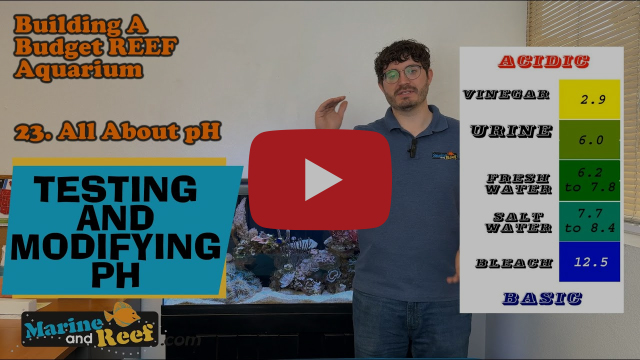
In this video we discuss pH. We explain why you should care about pH, how you can measure pH, and finally how you can fix pH problems if your pH is too high or too low.

PH is the ratio of acid to base inside your aquarium. It's measured on a scale from zero being as acidic as possible to 14 being as basic as possible. In chemistry, acidity and basicity are determined by the relative concentrations of hydrogen ions (H+) and hydroxide ions (OH-) in a solution. Acids have a higher concentration of H+, while bases have a higher concentration of OH-. A neutral solution has equal concentrations of both.

Why do we care about any of this? There are a few reasons. First off, the corals, fish and plants inside of your aquarium have lived their entire life at a very specific pH, and if you take them from that pH that they're used to, and you put them in a different pH, it can cause immediate stress and you can experience losses very, very quick.

What happens if your pH is high or low? If your pH is extremely high, it can cause precipitation of certain elements. Certain things will not be able to dissolve in the water. If your pH is particularly low it can actually start to melt some things in your aquarium, including the aragonite gravel, the rocks and ultimately the coral skeletons themselves which are made of that aragonite material. There's some very far extremes on that end. And finally, and probably most importantly, for reef aquariums the corals inside of our reef aquarium have a calcium-based skeleton. And in order for them to take the minerals out of that water and calcify them and turn them into new skeleton, it's much easier for them to do that if the pH is relatively high. If the pH is low they have to work harder at a higher metabolic cost to do that. And this means that at subdued pHs in saltwater aquariums, coral growth rates can be dramatically lower and elevated pHs or proper pH levels corals can grow far faster. And this can be the difference between your tank being filled with corals in a year or four years. It can literally be two to three times the growth rate in many cases.

So, why is it that we have not talked about pH so far in this video series? We've already had two different testing videos in this series, but we've never discussed pH. One video covered basic tests when you're starting out, and the other covered advanced tests. We didn't talk about pH in these videos because in most aquariums your pH is just going to be fine. You really shouldn't be stressing about it that much. But that being said pH is something that almost everybody is going to ask about. Almost everybody's going to be curious about. And it can make a big difference as far as how fast your corals grow. So we're going to show you guys how we measure your pH with the new MarineAndReef.com pH Tester. Then we'll discuss what do you do if the pH values are off inside your aquarium.

MEASURING PH
COLORIMETRIC TESTS
There are many ways you can measure the pH inside your aquarium. First off, you're going to get what I'm going to call a coloremetric test. This could be a strip that changes color when you put it in the water. It could be a vial that you add drops to that then change color. This is probably the most common way of measuring pH inside the aquarium. It does work. However, if you're color blind like I am, you may find yourself staring at a color chart squinting really hard. But ultimately it does do the job. And it's probably the most affordable way for most people to measure pH.

pH MONITORS
A pH monitor has a probe that sits inside of your aquarium and gives you a constant readout of the pH. This is a very advanced solution and what it's going to give you is a full trend of the pH throughout the day. Keep in mind that the pH of most aquariums is going to change significantly throughout the day based upon the photosynthesis happening inside the aquarium. The reason for this is that one of the most common things that affects pH in aquariums is carbon dioxide. Carbon dioxide is an input into photosynthesis so once the lights on your tank turn on the corals that photosynthesize and any algae or plants that are photosynthesizing in the aquarium suck the carbon dioxide down. And carbon dioxide functions as an acid. So at night when nothing's sucking the carbon dioxide out the pH goes down. And during the day as the photosynthetic animals do their thing, carbon dioxide levels go down. The ratio of the pH in the aquarium goes up. You are going to see an up and down of pH every single day in a normal aquarium. And these leave-in probes are a great way of measuring the changes throughout the day.

ELECTRONIC TESTERS
The third way to measure pH is with an electronic tester. In this video we use the MarineAndReef.com pH Tester. Though these are more expensive than simply buying a test kit, they last a long time. In the long run, if you regularly test pH they can wind up being cheaper because the calibration solution you need is generally cheaper than replacement reagents with colorimetric tests. And they're going to give you a nice digital readout that's very, very easy to read and understand even if you're a little bit colorblind like me.

The pH tester comes with three calibration packets, the meter itself, and a quick instruction manual. The first step when using any kind of pH meter is to calibrate that meter. Essentially, what we're doing is we're telling the computer inside the meter this is what a pH of 10 reads like, this is what a pH of 4 reads like, this is what a pH of 7 reads like. And the general rule when calibrating is you should use a two-point calibration. You should use two packets, and you want to use the packets that are surrounding the value you plan to be testing.

With a saltwater aquarium we expect the pH to be 7.8 to 8.4. That's generally the acceptable range. So when we're picking which packets to calibrate we'd want the pH 10 as above that range and the pH 7 as below that range. These are above and below the range we anticipate measuring. We would use the pH 4 instead of the pH 10 if we had an acidic freshwater aquarium or if we were trying to measure the pH coming out of a calcium reactor that often has very low pH.

These packets are powder that you dissolve in 250 ml of purified water. For future calibration you may want to get the liquid Milwaukee Calibration Solution. These are very affordable.

To calibrate, just make sure the solution is completely mixed. For the video demonstration we put it at 7.00. Just turn on the tester, hold down the CAL (calibration) button until you are at the pH you want, which in this case is 7.00. Just put the tester in the calibration solution. The tester will then know what 7.0 is. Don't worry if it then flashes 6.99 or 7.01--it's close enough. Just do the same for 10.0 for saltwater, or 4.0 for freshwater to complete the calibration. To go to 4.0, hit the CAL button once more. Then for 10.0 hit it once more. After use, clean the tester with pure or distilled water and dry it off.

Once the meter is calibrated, you can measure the pH of your aquarium water. Just turn on the tester and put it in a place of high flow. It's normal to see some variation. In our aquarium I get 8.26. That's a really good value. For reef aquariums anywhere between 7.8 and 8.5 is acceptable. I've seen some reef aquariums at 7.6-7.7 that look totally beautiful. But generally, the higher this number is, the easier your corals are going to have at calcification, which means they're going to be able to grow faster, which is a good thing.

A few things to note. With a pH pen, you are only getting a momentary pH measurement. In other words, we know what the pH of this water is right now. But as we mentioned earlier, the pH goes up and down throughout the day. If I measure the pH now and then after the lights go out this evening, it's going to be lower when the lights go out than it is now. That doesn't mean that our meter is inaccurate. It means that the pH in the water has changed because the animals are no longer photosynthesizing. If you are trying to get a graph or an idea of the trend in your pH you really want to measure that pH at the same time each day.

INCREASING/DECREASING PH
A lot of the methods for correcting the pH in your aquarium are rather advanced methods that require expensive gear. In this Budget Reef Series we're really not looking at buying lots of expensive gear to fix something that ultimately will only mean our animals grow faster. But that being said, we'll cover all the best methods for correcting pH.

PH TOO HIGH
What do you do if the pH is testing too high? You think of the ideal reef tank pH as 7.8 to 8.4, and you get a 8.5 or 8.6. I wouldn't worry about anything. If anything that super elevated pH is probably just really boosting the growth of your animals, and it shouldn't be a problem. But if your pH is 9 or 10, most likely some additive has been overdosed in the aquarium. It's probably a calcium or alkalinity additive, as many of these raise pH. Perhaps an automated dosing pump you programmed incorrectly to dose too much, or you simply poured in too much of something. If this is the case probably the best thing to do a water change. Find the mistake and don't make it again.

PH TOO LOW
What's probably more relevant is the problem of low pH. If your pH is too low it means your aquarium has too much acid. The first culprit you will want to look into is the cleanliness of the tank. A lot of organic molecules, such as rotting fish poop and uneaten food, are acidic. At times I've had aquariums that test chronically low and I simply just vacuum out the sand really well and it immediately goes up. It can make a big difference. Clean your tank, raise the pH and watch your coral grow bigger.

If you've cleaned everything, and you're still getting a depressed pH, the next biggest factor in lowering pH in most circumstances is carbon dioxide. Carbon dioxide is an acid and this is why you might have heard people say with increased CO2 levels we have ocean acidification. That's because the CO2 is acting as an acid and acidifying oceans globally. It can also acidify the water inside of your aquarium.

Where does CO2 in your aquarium mostly come from? It's going to come from the fish. They use oxygen and exhale CO2 into the water. If you have an aquarium with a glass lid, it's going to trap all the CO2. The fish are respiring and putting CO2 into the tank. Increasing ventilation will help to equalize the CO2 levels between the tank and the surrounding room. You could remove your glass lid or swap it for a mesh lid that ventilates better. If you don't have a glass lid, you could try adding cooling fans again to increase the evaporation rate which will help to equalize the CO2 levels between the water and the room.

However, if you have high CO2 levels in your aquarium room, it may not matter how well ventilated your aquarium is. The CO2 in the room comes from people and pets breathing. Modern homes can have high CO2 levels because they're sealed up so tight. To lower CO2 levels in the aquarium room you can open up windows, and some get fresh air into the room.

Some people will go as far as to get the protein skimmer airline, run that airline outdoors, drill a small hole in their wall, run it outdoors. It'll bubble fresh non-CO2 laden air into the water.

Another solution is to add a CO2 Scrubber. This is a special device that connects to your protein skimmer and sucks the CO2 out before it's bubbled into the aquarium. It has a special media.

Some other things you can do to boost your pH is you can switch your additives. Calcium and alkalinity additives increase pH. But this is a pretty advanced topic for this Budget Reef Tank series. Try the simple methods first.
More Info Product button block
  • Please contact us with any questions you have.

  • [email protected]

    We answer all emails through 3 PM the same day (M-F).

  • (480) 491-5283

    Monday-Friday 9:00 am to 11:00 am & 1:00 pm to 3:00 pm MT. We will return all phone calls through 3 PM the same day.

    Note: we do not have daylight savings time in Arizona

Empty Cart