How To Get Rid of Algae In An Aquarium
![]()
If you have an aquarium, then you will get algae. Here are the five ways to eliminate algae from your aquarium. In most cases you will need to use many or all of these algae removal methods to solve an algae problem. Severe problems will take more work, and no aquarium is completely algae-free, but with these tools you can get rid of the ugly green tank and instead have a beautiful and enjoyable aquarium.
1. Fix Your LightingAlgae needs light to live, but so do fish, corals, and plants. The first step in fixing your lighting is getting the light on a timer and setting a proper light schedule. For on/off lights, leave your lights on for no more than 8 hours a day. For dimmable/programmable lights, you can keep your lights on for 12 hours per day, but make sure that the peak intensity is for no more than 4 hours a day. In addition to setting the proper light schedule, you want the proper light intensity. For planted aquariums and reef aquariums, bright lights are needed to support photosynthesis, but for tanks with only fish, there is no reason to have super intense light. Dim your lights down or consider replacing them with lower-intensity lights.
2. Fix Your Water QualityIn addition to light, algae needs fertilizer to grow. In aquariums, nitrate and phosphate serve as fertilizers for pest algae. There are also some (algae-like) pests such as cyanobacteria and dinoflagellates that thrive in low-nutrient conditions. Getting your nutrient levels correct will reduce algae problems. We recommend nitrates below 20ppm but not 0, and phosphates below 1ppm but not 0. For information on how to reduce nitrates and phosphates, see our
How To Reduce Nitrates In An Aquarium and
How To Reduce Phosphates In An Aquarium articles. If you need to increase your nitrate and phosphate, then you can use products such as
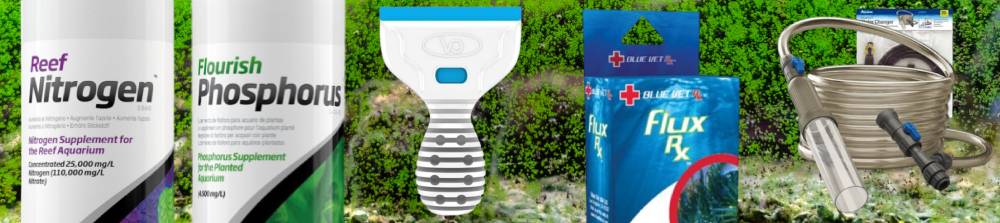
Seachem Reef Nitrogen and
Seachem Reef Phosphorus for saltwater aquariums and
Seachem Flourish Nitrogen and
Seachem Flourish Phosphorus for freshwater aquariums.
3. Manually Remove the AlgaeThere is no fixing an algae problem without doing the work. Clean your glass with a
scraper or scrub pad, scrub your rocks with a toothbrush, and vacuum algae off your substrate with a
gravel vac. Importantly, the algae doesn’t go away unless you remove it from the water. Scrubbing off algae and then leaving it to float around will only spread it around the tank. Suck the algae out with a siphon to completely remove it from the tank. Sometimes manual removal alone will fix an algae problem, but often you will need to manually remove algae and fix lighting and nutrients to keep the algae away for good.
4. Add HerbivoresHerbivores such as algae-eating fish, snails, crabs, shrimp, sea urchins, and nudibranchs. Can be excellent at keeping algae under control, but they aren’t very good at fixing an algae problem. Manually removing the algae, then adding some herbivores to the aquarium will help to maintain a tank with less algae. Do not try to fix a bad algae problem with herbivores. If you have a bad algae problem, then you will need a lot of herbivores to fix the problem. Once the algae has been eaten up, the herbivores will starve and die. Dead snails and crabs rot, producing waste that often makes the algae come back even worse than in the beginning. Instead, fix the problem with other methods and use herbivores to maintain low algae levels.
5. Use a Chemical TreatmentA chemical treatment should be the last resort method of fixing an algae problem, but it is a good tool to have. No chemical treatment is completely side-effect-free, but it is often better to use a chemical treatment than to tear down an entire aquarium. There are different algicides and treatments for different kinds of algae.
Brightwell Razor is good for treating marine hair algae and bubble algae,
Blue Life Flux RX is for treating bryopsis algae,
API AlgaeFix will help with diatoms and film algae, and
ChemiClean and
Ultralife Slime Remover are good at removing cyanobacteria. In planted aquariums
Seachem Flourish Excel is an excellent tool for removing algae from plant leaves.