Free Shipping on all orders over $49 • $5.99 Flat Rate Shipping on orders under $49.
Free Shipping on all orders over $49 • $5.99 Flat Rate Shipping on orders under $49.
Free Shipping on all orders over $49 • $5.99 Flat Rate Shipping on orders under $49.

Phosphate is an organic molecule that is considered a waste product and a pollutant in aquariums. Because phosphates are organic, they come from any former living matter added to the aquarium: fish poop, uneaten food, amino acid supplements, plant fertilizers, dead fish, dead corals, or dead plant leaves, or even fresh live rock or driftwood.
Phosphates can be problematic because they can cause unwanted algae growth and stunt coral growth. Importantly, zero phosphates can also be problematic because water plants and corals use small amounts of phosphate to grow and build their bodies. The ideal phosphate levels in a planted aquarium are below 1 ppm but not zero, and for a reef aquarium below .5 ppm but not zero.
What do you do if your phosphates are too high? Here are some ways to lower your phosphate levels.
Since phosphate enters the water through organic matter feeding, less will lower the amount of organic compounds entering the aquarium and can lower phosphate levels over time. Try feeding less often or in smaller amounts. If you are using specialized food additives like amino acids, then lower the dosage or stop using them temporarily. These liquid additives are often very high in phosphate. At some point you can’t feed any less and keep your fish healthy. If you are feeding as little as you can and still have high phosphates, then move on to other methods.
Yes, water changes are the great solution to nearly all aquarium problems. Here are some things to keep in mind when using water changes to lower phosphates.Firstly, water changes only work if the clean water you are adding back to the aquarium is better than your tank water. Often, phosphate is present in tap water, so test your source water and ensure it is phosphate-free. If you have anRO system and you see phosphate in your product water, then it is time to replace your filter cartridges. If your tap water contains phosphate, you should consider switching to RO water.
Secondly, don’t forget your water change math. If you have a phosphate level of 5 ppm and want it to drop below 0.5 ppm, you will need to do 4 50% water changes with zero-phosphate water to get there. Each water change will remove half the phosphate, so this is what your phosphate levels should look like.
In a small 10-gallon aquarium, doing a 50% water change every other day for a week can be an easy way to lower phosphate. In a large 300-gallon aquarium, this can be labor- and cost-prohibitive. For large aquariums, consider adding some extra phosphate filtration to your aquarium filter system.
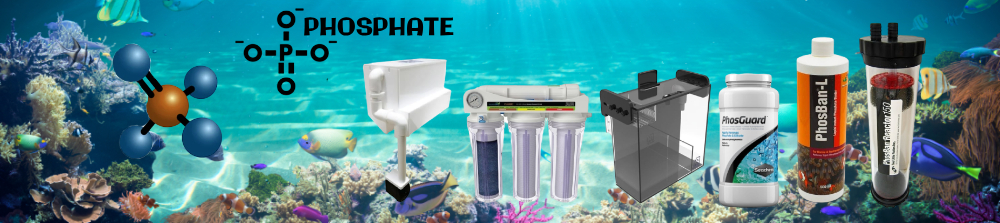
One of the best ways to remove phosphate is with algae and plant filtration. Plants use phosphate as a fertilizer as they grow. When you use an algae-based filter, such as a refugium with chaetomorpha algae in saltwater aquariums, or an algae turf scrubber in freshwater or saltwater aquariums, the algae remove phosphate from the water and incorporate it into their bodies as they grow. When the algae is trimmed or pruned, the phosphate is removed with the discarded algae. You can add algae filtration with a refugium like the Fiji Cube Hang-on Refugiums, or with an algae turf scrubber like the IceCap Pro Turf Scrubbers.
Likely the easiest way to give your filtration more phosphate removal power is with a phosphate-removing filter media. There are two main types of phosphate-removing media in the aquarium hobby: aluminum-based and iron-based. Aluminum-based media can be more effective at removing very high phosphate levels. Still, if it is left in the aquarium for too long, it can leach aluminum back into the aquarium water, which can poison tank inhabitants. For this reason, we recommend iron-based media commonly known as GFO, since it is safer. The most popular aluminum phosphate remover is Seachem Phosguard. Some popular GFO medias are the Two Little Fishies PhosBan and the CoralVue Reef Endurance Bulk GFO.
To use phosphate removal media, rinse it in tap water, then add it to a bag or media reactor and ensure it has plenty of flow. When added to a media reactor, GFO should be lightly tumbling. The media will absorb phosphate until it is fully saturated, at which point it will need to be replaced. We recommend using small amounts of media and replacing it once a month. Using more media removes more phosphate, and using less media removes less phosphate.
The most efficient way to use phosphate-removing media is with a media reactor. The reactor will directly force water through the media, and the flow can be set to tumble the media, ensuring the water flow is evenly distributed over the media's surface. There are lots of reactors to choose from, but a classic choice that remains one of our favorites is the Two Little Fishies Phosban Reactor. These come in three sizes for different aquarium sizes, and they can be used in a sump or hung on the side of an aquarium or sump.
Lanthanum chloride is a liquid chemical used for phosphate removal. You add the liquid to the aquarium water, and phosphate attaches to the lanthanum, forming solid lanthanum phosphate particles. These tiny particles are removed with mechanical filtration or a protein skimmer. Do not use lanthanum chloride without a properly sized protein skimmer.
The advantages of lanthanum chloride are many. Because it is a liquid, you do not need a specialized media reactor to use it. Lanthanum chloride can also be easily dialed up or down by adjusting your dosage. Most importantly, lanthanum is extremely effective at reducing very high phosphate levels to low levels, and it is far cheaper than solid phosphate-removal filter media per the amount of phosphate removed from the water. This makes it very common in public aquariums or large aquariums with serious phosphate issues.
There are some disadvantages to lanthanum chloride phosphate removers. If they are overdosed, an abundance of lanthanum phosphate particles can clog the gills of certain fish, leading to their death. Additionally, the chemicals are often super concentrated, making overdosing easy to do by accident. You must remain patient and follow the directions. If you are nervous, go slow and even start with half the recommended dosage. We have never seen anyone have any fish losses with lanthanum chloride unless they did not follow the manufacturer's directions.
Some of our favorite lanthanum based phosphate removers are Blue Life Phosphate RX and Two Little Fishies Phosban L. Phosphate RX comes in an easy-to-use dropper bottle, perfect for small, manual additions when fixing a phosphate problem. Phosban L is super concentrated and needs to be diluted before use, but it is likely the most budget-friendly phosphate remover available. It is great for use with a dosing pump, adding small amounts daily to maintain low phosphate levels.
We answer all emails through 3 PM the same day (M-F).
Monday-Friday 9:00 am to 11:00 am & 1:00 pm to 3:00 pm MT. We will return all phone calls through 3 PM the same day.
Note: we do not have daylight savings time in Arizona