Free Shipping on all orders over $49 • $5.99 Flat Rate Shipping on orders under $49.



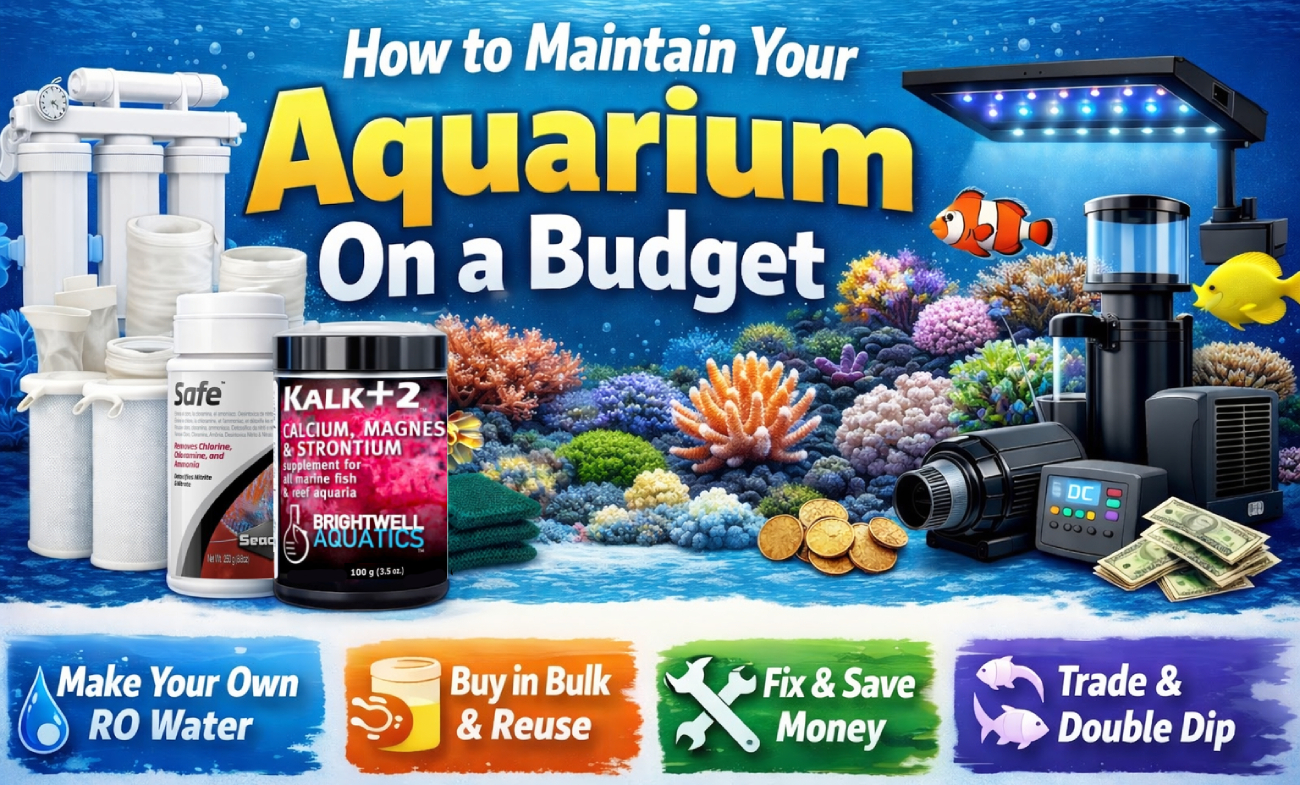
We love spending money on our aquariums, but we would much rather buy new fish than maintenance items such as filter media and additives. Here are some simple ways to lower the ongoing maintenance costs of your aquarium.
1. Make your own RO water
If you have a saltwater or planted aquarium, you most likely use RO water to top off your tank and perform water changes. You can purchase RO water at an aquarium shop or a grocery store, but it is much more affordable and convenient to produce your own. Using your own RO system will save money in the long run compared to the cost of purchasing water and the gas to pick it up locally.
2. Buy dry additives in bulk
Many aquarium keepers like the ease of use of a ready to use liquid aquarium additives, but there are significant savings when additives are purchased in bulk. Brightwell Aquatics makes bulk dry reef aquarium additives. Seachem Safe is a good choice for bulk dechlorinating in freshwater aquariums. In many cases, the main cost of aquarium additives is shipping and packaging. The dry form factor dramatically lowers these costs, making dry additives a much better bang for your buck.
3. Use reusable and bulk filter media
One common cost of keeping aquariums is replacement filter media. Whether it's filter cartridges, filter rolls, or filter pads, they need to be purchased and replaced regularly. Switching to filter socks or sponges that can be washed and reused will help to reduce the cost of replacement media. It is also important to keep this in mind when picking out gear. Filters such as the Seachem Tidal feature a large open bin for your choice of bulk filter media, whereas other hang-on filters accept only a proprietary disposable cartridge. Nuclear Canister Filters can have their cartridges cleaned and reused for many years and don’t require constant replacement media. One of our favorite medias is Sera Crystal Clear. This fine floss can be washed and reused several times because it is a spun plastic material rather than wool, making it a great value. Crystal Clear can go in hang-on filters, canister filters, or even in a prefilter bin in some sumps.
4. Use gear that doesn’t require consumables
When picking your gear, pick items that don’t require regular replacement media or parts. Chemical filtration media and organic carbon dosing require constant media replacement. Using a protein skimmer, refugium, or algae turf scrubber for filtration will not require purchasing any replacement media. Upgrading to LED lights means no more replacement bulbs. Some pumps are notorious for needing impeller and bushing replacements, while others only require regular cleaning.
5. Use energy-efficient gear
The cost of running your tank isn’t just in replacement media; it is also in your electric bill. See our article: How To Save On A Tank's Electric Bill. Switching to a DC return Pump or LED lights can save you money in the long run.
6. Apply the KISS Principle to your setup.
We sell lots of gear on MarineAndReef.com, and we don’t carry products we don’t believe in. With that said, there is some specialized gear that is great in some circumstances, and useless for most people. Every additional piece of gear is another device that requires electricity, maintenance, and eventual replacement parts. It is best to pick high-quality essential gear and include only extra gear that provides a substantive benefit to you and your unique aquarium. For freshwater aquariums, get high-quality lighting, a filter, and a heater. For saltwater aquariums, pick high-quality lighting, a high-quality protein skimmer, good circulation, and a high-quality heater. Every additional piece of gear should be included only if the benefit outweighs the extra maintenance and cost.
7. Fix stuff instead of buying new
At MarineAndReef.com, we hate the throw-away culture of aquarium gear. We prefer gear that lasts, and we want to keep your gear running as long as possible. Fixing old gear is far more affordable than regularly replacing gear every time something goes wrong. See our Fix It or Pitch It? article for more information on when you should fix something and when you should buy something new.
8. Double Dipping?
What do we mean by double-dipping? Using non-aquarium stuff for your aquarium. Some examples of this include: feeding your aquarium fish food from the grocery store, such as seaweed, zucchini, table shrimp, or chopped fish, using a magic eraser to clean your glass, using a turkey baster as a coral feeder, and using RO water to clean your glass and get rid of salt creep.
9. Trade in livestock
For those who have planted or reef aquariums, successful tanks will result in plants and corals that need trimming. Selling or trading plant trimmings or coral frags can help offset the cost of maintaining your aquarium. You can see if your local store will take the plants or coral frags as a trade-in, or you can check your local aquarium clubs to see if people are interested in buying or trading.
10. Spend where it matters
There are certainly things worth spending extra money on. High-quality pumps and lights will last longer and perform better than cheap versions, but many items have become near-commodities, and the difference between brands is minimal. Here are some categories where going with a more affordable option can make a lot of sense.
- Salt Mix (as long as it is from a major brand)
- Kalkwasser
- Carbon (as long as it is phosphate-free)
- GFO
- Coral glue
- Catappa leaves
- Seaweed
- Fish nets
- Scrub pads
We recommend you invest more in electrical items (pumps and lights) and plumbing parts, as these are non-consumable. Higher-quality items usually last longer and perform better. Common maintenance items are where money can be saved.