Jaron's Favorite Test Kits & Test Equipment - Product Spotlight
![]()
There are lots of thermometers out there. I prefer to read digital thermometers, but my biggest complaint has always been that most of the digital thermometers in this hobby take tiny watch batteries that I never have on hand and often cost as much as the thermometer to replace. My current favorite thermometer is the
Lifegard Aquatics LED Digital Thermometer. This thermometer has a standard wall plug, so you never have to worry about the batteries dying. Because the wall plug can use more power than watch batteries, the Lifegard digital thermometer also has a very bright display that makes the numbers much easier to read in dark cabinets.
SalinityThere are a variety of different salinity measurement tools out there. Since I have had eye surgery, it has gotten hard for me to use a standard refractometer, so I have fallen back on digital readers. My personal favorite is the
IceCap Salinity/Temp Digital Pocket Tester. There are other meters out there, but I have found that some of them have sensors too wide to fit into the bottle of my favorite calibration solution,
Two Little Fishies AccuraSea. The salinity tester is fast, easy to calibrate, and pretty affordable for a digital meter.
pHIn most of my tanks, I measure pH through an aquarium controller such as Neptune or Hydros. It is just much better to get a continual reading rather than a momentary test. Over the years you will need to replace the probes on your aquarium controllers, and I have found the
Milwaukee pH and ORP probes to be an excellent value. These are high-quality double junction probes that read as accurately as anything else I have tried, and they are substantially cheaper than many other options. They have a standard BNC connection that makes them compatible with nearly every meter and aquarium controller on the market.
AlkalinityThere are now many automatic alkalinity testers available, and I do use them. They can be a bit overkill on certain tanks, and even on the tanks where I use them, I still periodically check the alkalinity with a manual test to confirm the unit is working properly. My favorite is the
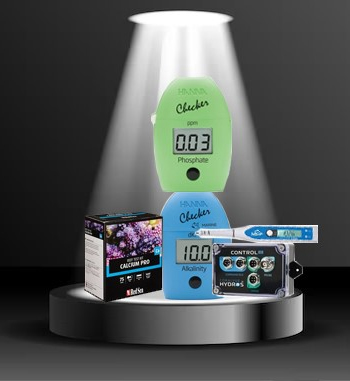
Hanna Seawater Alkalinity (dKH) Colorimeter Checker. The Hanna Checker uses one reagent and is fast and easy to use. The digital display is easy to read, and the checker itself only costs about as much as two colorimetric test kits.
PhosphateI also like the
Hanna checkers for phosphate. I have a hard time telling the colors on traditional test kits, and I like the digital reading of the Hanna Checkers. There are at least three different phosphate/phosphorus checkers from Hanna. My go-to is the
Hanna Low-Range Phosphate Checker (rather than the Ultra Low-Range Checker). I do not typically run ultralow nutrient systems, and I don’t think most reef keepers do either. This checker is the right choice for most people with normal phosphate levels. It uses one simple reagent and is easy to use. The checker does have a 3-minute waiting period after adding the reagent for the test reaction to complete and give you results. Just don’t forget to check after three minutes. If you wait too long, the unit will turn off and you won’t get your results.
NitrateJust like with phosphate, I prefer the Hanna checker for nitrate testing. There are two nitrate checkers, the h
igh range and the low range. The low range is too low for most people, and there are multiple reagents and steps, making testing difficult. I like and recommend the high-range checker. It uses one reagent and is more accurate in the range most people will use. Just like with the Phosphate Checker, there is a waiting period after you run the final test. Make sure you come back in time to see the final result.
CalciumWhile it may sound like I like Hanna checkers for everything, I am not a fan of the Hanna Calcium checker. The test process is complicated, and the results are not as accurate as other checkers. I prefer to use a simple colorimetric test for calcium testing. The
Salifert Calcium Aquarium Test Kit has served me well for many years and is what I still use. This is a more complicated test with multiple reagents, but I find it accurate. It's a good value and comes with 50-100 tests.
MagnesiumI don’t often test for magnesium, but in some systems in the past, magnesium consumption was crazy high, and I tested much more regularly. I mostly use standard color metric tests, but I have recently tried the new
Hanna Magnesium Colorimeter Checker. When these checkers first came out, there were many reports of inaccurate readings. It turns out this was because small amounts of liquid reagent were evaporating and changing the reagent concentration. The new checkers use powdered reagents instead to avoid this problem, and since the switch, we have had good results and no more customer complaints.