Free Shipping on all orders over $49 • $5.99 Flat Rate Shipping on orders under $49.
Free Shipping on all orders over $49 • $5.99 Flat Rate Shipping on orders under $49.
Free Shipping on all orders over $49 • $5.99 Flat Rate Shipping on orders under $49.

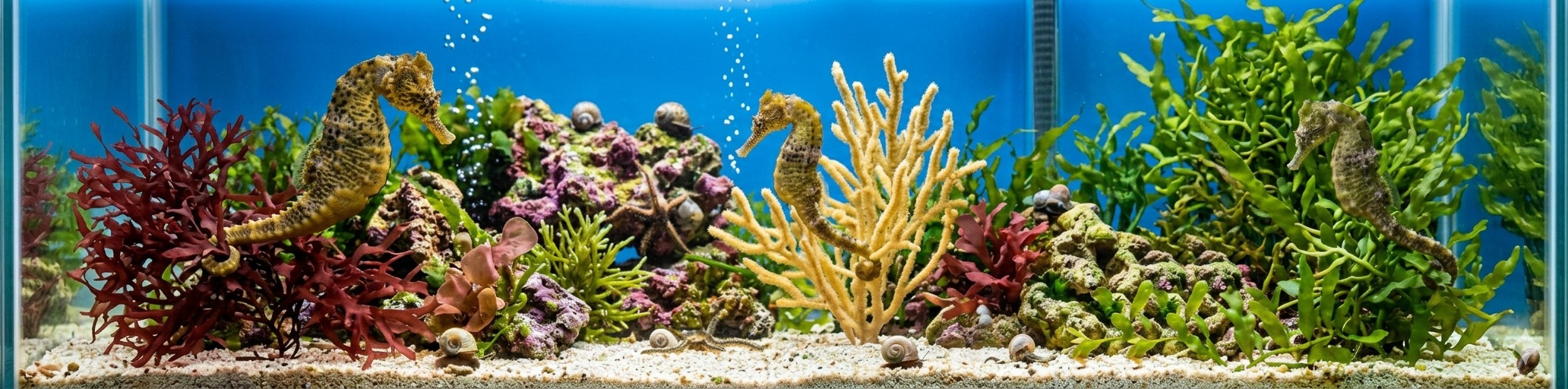
Seahorses are among the most beloved inhabitants of the ocean. While many aquarium enthusiasts dream of adding them to their home tank, they are often discouraged by claims that seahorses are "impossible" to keep. The truth is that seahorses don't have to be difficult, provided you select the right specimens and design a system specifically for their needs.
The most challenging aspect of seahorse husbandry is feeding. These animals have small mouths and no small stomachs, necessitating frequent meals of small food items. Generally, larger species are easier to keep because a larger mouth means larger food particles can be fed.
Beyond species selection, it is vital to choose aquacultured (captive-bred) specimens. These animals are already adjusted to aquarium life and, most importantly, are trained to eat prepared foods. If possible, observe them feeding before purchase. If you are ordering online, confirm that the source is not feeding live food exclusively, as transitioning a "live-only" eater to frozen food can be difficult for beginners.
Small species, such as the true dwarf seahorse, can thrive in 20–30-gallon aquariums. However, for the larger species, a minimum of 50 gallons is recommended. While seahorses are not high-energy swimmers, a 12-inch fish needs vertical height and enough volume to move comfortably and maintain stable water chemistry.
Because seahorses have small stomachs, they should be fed as often as possible. While public aquariums may feed every hour, this is impractical for most home hobbyists. Aim to feed at least twice per day with high-quality frozen food.
Seahorses are gentle swimmers and can easily be overwhelmed by high-flow environments. It is common for them to be injured by powerful suction from pump intakes or powerheads.
Filtration in a seahorse tank is a balancing act: you need to manage the heavy waste from frequent feedings without creating turbulence.
· Turnover: Aim for a turnover rate of 2–4 times the tank volume through the sump or AIO chamber.
· Efficiency: Use an oversized protein skimmer and fine mechanical filtration (like filter socks or rollers) to remove waste quickly.
· Nutrient Control: Utilize media reactors or a refugium to keep nitrates and phosphates in check.
· Avoid: Large canister or hang-on-back filters that create high-suction hazards.
We strongly recommend a species-specific tank. Most reef fish are too fast and will outcompete seahorses for food, while crabs (even hermit crabs) and stinging corals pose a physical threat. However, the following make excellent companions:
Due to low water movement and heavy feeding, detritus can settle quickly in the substrate. To prevent nutrient spikes, a diligent maintenance schedule is required. We recommend vacuuming the substrate and performing a significant water change at least twice a month to keep the tank clean.
MarineAndReef.com © 2026
We answer all emails through 3 PM the same day (M-F).
Monday-Friday 9:00 am to 11:00 am & 1:00 pm to 3:00 pm MT. We will return all phone calls through 3 PM the same day.
Note: we do not have daylight savings time in Arizona