Free Shipping on all orders over $49 • $5.99 Flat Rate Shipping on orders under $49.
Free Shipping on all orders over $49 • $5.99 Flat Rate Shipping on orders under $49.
Free Shipping on all orders over $49 • $5.99 Flat Rate Shipping on orders under $49.

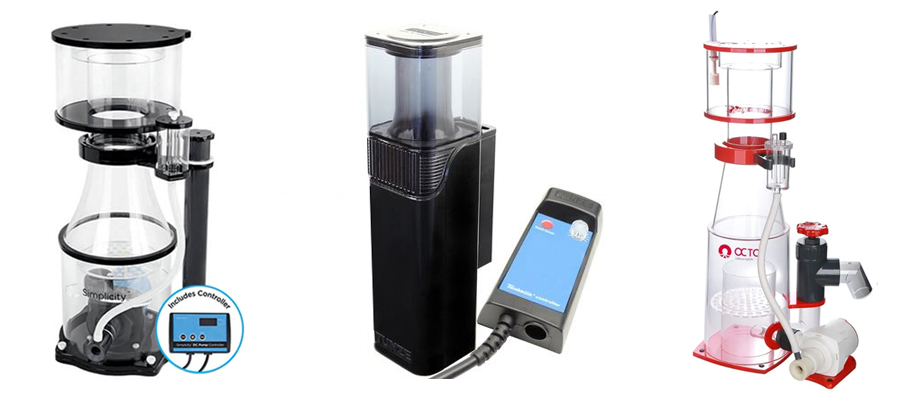
Protein skimmers are an iconic part of saltwater aquarium keeping. They're unique filtration devices that use air bubbles to clean the aquarium by pumping bubbles and water into a chamber, where waste particles attach to the bubble surface. As the bubbles rise in the reaction chamber, they eventually pop—releasing all of the waste that was trapped on their surfaces. The waste attached to the bubbles is collected in a cup so it can be dumped out and removed from the aquarium ( a more scientific explanation of this process is at the end of the article ).
If you have a saltwater aquarium over 30 gallons, you should use a protein skimmer. They're superior to canister filters and power filters, reasonably priced, and they require little maintenance.
A protein skimmer is not necessary to keep a saltwater aquarium, but we still recommend it in most cases. They can remove up to 40% of dissolved organics, which can mean 40% fewer water changes. They also oxygenate the water well, improve clarity, and uniquely remove waste before it can turn into the toxic nitrate and phosphate most aquarists struggle to control.
One instance where we might not recommend a skimmer is for small nano and pico aquariums. It is very difficult to design and manufacture small protein skimmers. For aquariums 30 gallons and under, you will need a very small protein skimmer. These small skimmers are much more difficult to adjust than larger skimmers, and they are never as effective as a larger skimmer. For small saltwater aquariums, it is often easier to increase the frequency or size of your regular water changes rather than add a skimmer. If you have a saltwater aquarium larger than 40 gallons, we always recommend a protein skimmer.
Unfortunately, protein skimmers do not work with freshwater aquariums. Protein skimmers require a high density of saltwater to create fine air bubbles. Without the fine bubbles, protein skimmers are so ineffective that they are not worth using.
With other types of filters, you are not actually removing waste. Instead, you hold the waste in some filter media and pump aquarium water through it. You only remove the trapped waste when you clean the filter and wash or replace the media. Many people clean their filter only once a month. With a protein skimmer, the waste is removed from the water and transferred to the collection cup. This is a huge advantage of the protein skimmer. It is the only form of mechanical filtration that actually removes nitrate, nitrite, ammonia, and phosphate.
There are protein skimmers that can hang on the back of aquariums, sit in a filtration sump, sit in the chamber of an all-in-one aquarium, or sit inside the main aquarium display. Protein skimmers don't use filtration media and don't require replacement parts beyond what you might break or lose by accident. This means you will save money compared to other filtration methods that require you to buy new filter media continually.
When you first set up your protein skimmer, you will need to adjust it to get it skimming properly. There are several ways of adjusting a skimmer. Some use a water-level adjustment, some a pump-speed adjustment, and some an air-inlet adjustment. The goal of adjusting the protein skimmer is to get a relatively dark, coffee-colored liquid in the skimmer collection cup. Lowering the skimmer water level, slowing down the pump, or reducing the amount of air will lead to a darker liquid. Raising the water level, speeding up the pump, and increasing the amount of air will all lead to a lighter liquid. When first tuning a protein skimmer, it may take 1-2 weeks to get it dialed in. During this time, check the skimmer daily to see what is collecting in the cup, then adjust accordingly to make the liquid lighter or darker. Once you are familiar with the skimmer, you will be able to readjust the skimmer in only a couple of minutes, and you may only need to readjust the skimmer every 1-2 weeks.
When your skimmer cup is full of skimmate (skimmate is the word for the nasty-looking crud that accumulates in the skimmer cup), you will need to dump out the liquid and clean the cup. We recommend cleaning the cup once a week, even if it is not full. As the neck of the skimmer cup gets gunked up, it gets harder for the skimmer to collect waste, so cleaning the skimmer cup will help your skimmer perform better. To clean the skimmer cup, remove the pump and take it to a sink. Dump out the liquid and use a sponge or algae pad to wipe down the skimmer cup, especially the skimmer neck, and then replace the cup on the skimmer body. This should only take 5-10 minutes.
About twice a year, deep-clean your skimmer. Remove the skimmer from the aquarium and rinse it under a sink, wiping down the skimmer's surfaces. Remove the pump and submerge it in a solution of citric acid overnight. After the pump has soaked in the acid, rinse it. Reattach the pump to the skimmer and return the skimmer to service.
Waste compounds in aquariums are often polar molecules—they have two sides with different electrical charges. One side is hydrophilic (attracted to water), and the other is hydrophobic (repelled by water). As a result, much of the dissolved waste can collect at the water's surface, where one side of the molecule touches the air, and the other touches the water. Think of the oil-like scum that you can see on the surface of a dirty pond or aquarium.
Protein skimmers use an open-top tube filled with bubbles, with a cup over the open top. Waste molecules are attracted to the bubbles because there is air inside the bubbles and water outside them. As the bubbles rise to the top of the tube, they pop and release all of the waste on their surfaces. The waste is collected in a cup.
We answer all emails through 3 PM the same day (M-F).
Monday-Friday 9:00 am to 11:00 am & 1:00 pm to 3:00 pm MT. We will return all phone calls through 3 PM the same day.
Note: we do not have daylight savings time in Arizona