





You are here: Home > HEATERS
Choose a sub category:
7.5 & 15 Watt Heaters 100 & 150 Watt Heaters
200 & 250 Watt Heaters 300, 400, 500 & 1000 Watt Heaters
50 & 75 Watt Heaters Aquarium Heaters: Ebo Jager
Aquarium Heaters: Hydor Hydrokable Aquarium Heaters: Hydor In-Line
Aquarium Heaters: Hydor Theo Aquarium Heaters: Hydor Thermopump
Aquarium Heaters: Pacific Coast Imports Titanium
AQUARIUM HEATER GENERAL INFO

In almost all cases you will need an aquarium heater to maintain the temperature of your tank. If the temperature of your house gets below the required temperature of the organisms in your aquarium, you will need an aquarium heater.

Different Types of Heaters:
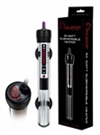
  • The Ebo Jager aquarium heaters are very precise and come in 50 watt, 75 watt, 100 watt, 150 watt, 200 watt and 250 watt sizes. These heaters are made of Pyrex glass and can only be submerged to just below the point of the temperature controller.
  • The Hydor 200 watt and 300 watt Inline aquarium heaters are placed inline with a water line outside the tank. This serves the purpose of removing a potentially unsightly heater from the tank.
  • Hydor's Hydrokable 50 watt and 100 watt aquarium heaters use a cable placed beneath the surface of the substrate to heat the water.
  • The Hydor Theo submersible aquarium heaters are made of shatter-proof glass and can be completely submerged. They come in 50 watt, 100 watt, 200 watt, 300 watt and 400 watt versions.
  • The Hydor Thermopump is a combination aquarium heater and pump. This is a great space saver.
  • The Pacific Coast Imports Titanium aquarium heaters are fully submersible heaters made of durable titanium. The heater controller is external and the heater comes in 300 watt and 500 watt versions.
Heater Tips:
  • 3-5 watts per gallon is recommended for keeping your aquarium at optimal temperatures
  • Abnormally cold houses will require more watts per gallon
  • Using more than one heater is advisable because heaters ultimately will fail one day and having a backup heater will keep your tank temperature from fluctuating wildly in the interim before you can replace your heater.
  • When changing the temperature of your tank, proceed slowly. Sudden temperature changes stress fish and corals
  • Fluctuations in temperature may cause stress in your corals and fish