






|
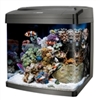
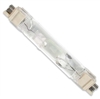
METAL HALIDE AQUARIUM LIGHTING GENERAL INFO There is no other practical lighting source for an aquarium that will provide as much light intensity in a small space as metal halide aquarium lighting. This is why they've become popular for reef aquarists. The need for light intensity provided by metal halides becomes important as tanks become deeper. Generally, metal halides are practical for reef tanks 16 or more inches deep and become a necessity for tanks deeper than 24 inches. Even deeper tanks and more demanding stony corals, such as Pavona, Goniopora, and certain Acropora species need 250 watt or even 400 watt metal halides for success. Metal Halide Aquarium Lighting FixturesIf you don't have a canopy, you will probably want a lighting fixture (or lighting hood) that sits on top of your tank, such as the:
To choose the best light for your reef aquarium please visit the Hood Lighting Chart
Metal Halide Aquarium Lighting Retrofits If your aquarium has a canopy (usually a wood box cover) you probably want a retrofit, such as the
These lights come complete with the bulbs mounted to a reflector--you just need to screw the reflector to the canopy. The only other thing you'll need to complete your lighting system is at least one canopy fan to dissipate the heat.
To choose the retrofit light for your reef aquarium please visit the Retrofit Lighting Chart
The Glitter Effect Many people find metal halide aquarium lighting more attractive than fluorescent lighting types such as VHO or power compacts. Why is metal halide more attractive? In natural reef environments surface waves act as a lens that focuses light and create "glitter lines." These glitter lines, familiar to divers, appear as flashes of light of high intensity and short duration and are very attractive to the eye. In reef aquariums these glitter lines, or flashes, can be created through the use of point source lights, such as metal halide lights, and surface agitation of the water. Fluorescent lighting is more diffuse and does not create these effects. Whether this flashing light is advantageous to the corals is not known.
Light Penetration The intensity of light decreases by the square of the distance that area is from the lighting source. In other words, if you double the distance between the light and the organism, you will quarter the amount of light reaching the organism. Keeping your light close to the top of the water will mamimize the amount of light reaching your organisms. However, be sure to have a glass or acrylic cover on the top of the tank so saltwater does not get into lighting system.
Metal Halides For Smaller Tanks Metal halides usually put out more than 150 watts (though we do have a 70W metal halide), so they may be too much for smaller aquariums. However, if you use a Pendant, the fixture can be placed some distance from the water, thus reducing the intensity, and spreading the light out better over the entire aquarium.
Overheating Overheating is a potential threat when metal halides are used. However, with good air circulation provided by fans, which are included with all the metal halide aquarium hoods we sell, and a cool air-conditioned house, significant increases in water temperatures may not occur. Chillers can be used to offset any temperature gains. Always purchase at least one canopy fan for use with metal halide retrofits.
Whenever installing metal halides, be sure to make frequent water temperature checks.
Metal Halide Lamp Color Temperature Reef tanks require roughly one-third to one half the lighting to be actinic lighting and half to two-thirds the lighting to be full spectrum daylight lighting. Metal halide lighting systems often come with either compact fluorescent or T5 bulbs along with the metal halide bulbs. Typically, the metal halide bulbs are full spectrum daylight bulbs and the compact fluorescents or T5s are actinics.
For the actinics any bulb listed as an actinic--whether it is a True Actinic, 7,100K Actinic, Actinic or 420nm Actinic--will be adequate. For the daylight bulb the best bulb for corals is the 10K (aka 10,000K) bulb. 6,500K 6,700K, 8,800K, 12,000K, 14,000K & 20,000K bulbs are also fine.
Freshwater planted tanks usually use the 6,700K, 6,500K or 5,500K bulbs and do not use actinic bulbs. All of our metal halide lighting systems are for reef aquariums, though you could swap out the actinic bulbs in any system for use with a freshwater planted tank.
Fish only tanks can use any light that makes the fish look good. The fish really don't need much light to survive--so it is really a matter of aesthetics. Most people will be happy using 6,700K bulbs, which are very close to daylight, for fish only tanks.
|
|
|